SAP S/4HANA for Chemical Industry: The Complete ERP Guide for 2026
Key Takeaways
- SAP S/4HANA gives chemical manufacturers batch level traceability from raw material to finished goods.
- Built in compliance tools help manage REACH, GHS, and other regulatory documentation without manual tracking.
- Real time production visibility reduces downtime and helps avoid costly batch rejections.
- The 2027 SAP ECC deadline means most Indian chemical manufacturers need to plan their S/4HANA migration now.
- Choosing a certified SAP Gold Partner reduces implementation risk significantly.
Why Chemical Manufacturers Need Industry Specific ERP
A general purpose ERP system was not built with chemical processes in mind. Chemical manufacturing involves variable yields, hazardous material handling, strict batch documentation, and formulas that can change based on raw material purity. A proper chemical industry ERP needs to handle all of this without forcing your team to build workarounds.
Batch and Formula Management
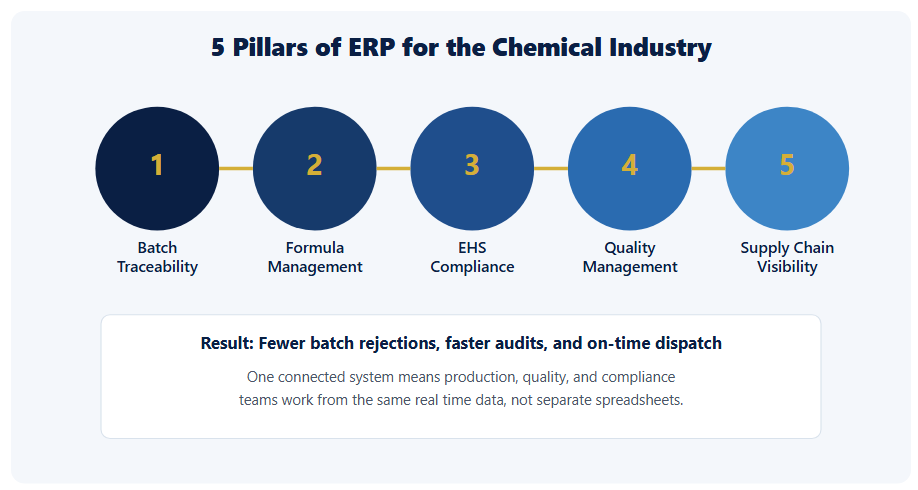
Every batch in chemical production carries its own genealogy. SAP S/4HANA tracks batch numbers, raw material lots, and formula versions together, so if a quality issue is found later, you can trace it back to the exact source in minutes instead of days.
Regulatory Compliance and Safety Data
Chemical companies operate under constant regulatory scrutiny, covering safety data sheets, hazard classification, and environmental reporting. SAP’s Environment, Health and Safety (EHS) module keeps this documentation connected to the production record instead of sitting in a separate filing system.
Quality Management at Every Stage
Inspection lots, certificates of analysis, and non-conformance tracking all live inside the same system as production and sales. This means a quality hold automatically stops a shipment before it leaves the warehouse, rather than relying on someone remembering to check.
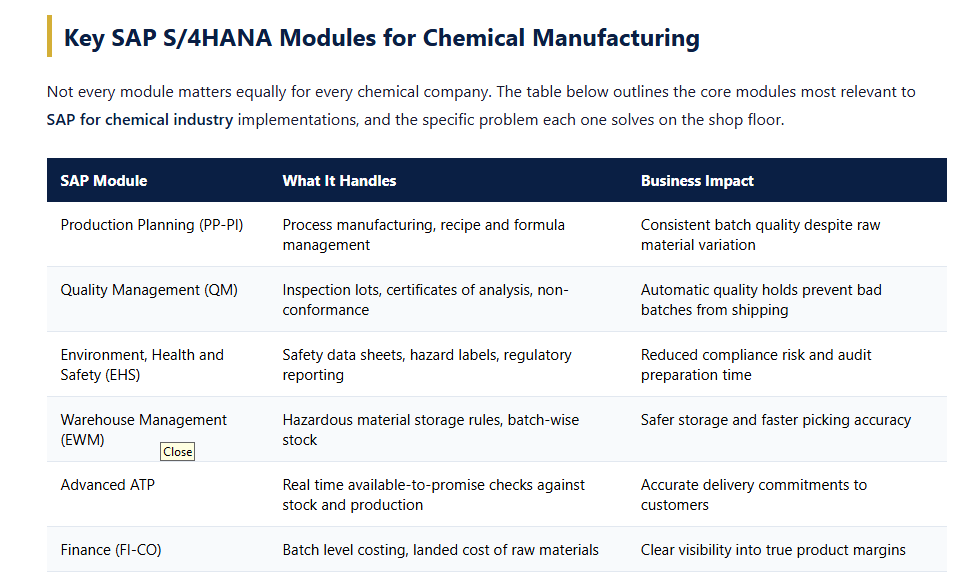
Key SAP S/4HANA Modules for Chemical Manufacturing
Not every module matters equally for every chemical company. The table below outlines the core modules most relevant to SAP for chemical industry implementations, and the specific problem each one solves on the shop floor.
Benefits of ERP for Chemical Manufacturing
Reduced Batch Rejections
When formula deviations and quality checks are tracked automatically, fewer batches slip through with errors that only get caught at the customer end.
Faster Regulatory Audits
Instead of pulling records from five different files, auditors get a complete, connected batch history in one screen.
Better Demand and Production Planning
Real time data on raw material availability and production capacity means fewer last minute scrambles to meet delivery dates.
Lower Total Cost of Ownership Over Time
A single connected system reduces the licensing and maintenance overhead of running multiple disconnected tools for inventory, quality, and finance.
The 2027 SAP ECC Deadline: Why Timing Matters
SAP has confirmed that mainstream maintenance for SAP ECC ends in 2027. Chemical manufacturers still running ECC or older systems need to start planning their SAP S/4HANA for chemicals migration now, since implementation timelines for process industries typically run six to twelve months depending on the complexity of existing formulas and compliance requirements. Waiting until the deadline year means competing for implementation partner bandwidth with every other company doing the same thing at once.
How to Choose the Right ERP Implementation Partner
Not every implementation partner understands process manufacturing. When evaluating vendors for chemical manufacturing ERP, look for:
- Proven experience with process industries, not just discrete manufacturing
- Certified SAP Gold Partner status
- A clear post go-live support structure, not just implementation and exit
- Reference clients in chemical, pharmaceutical, or similar regulated industries
Softwin Technologies is an SAP Gold Partner under Osswal Infosystem Pvt. Ltd., working with manufacturing, pharmaceutical, textile, and FMCG clients across Madhya Pradesh, Chhattisgarh, and Rajasthan. Our team has hands-on experience implementing SAP S/4HANA for process industries where batch accuracy and compliance are non-negotiable.
Frequently Asked Questions
Is SAP S/4HANA suitable for small and mid-sized chemical companies?
Yes. SAP S/4HANA Cloud and on-premise editions both scale to mid-sized chemical manufacturers, and modules can be implemented in phases rather than all at once.
How long does a typical chemical industry ERP implementation take?
Most implementations for process manufacturers take between six and twelve months, depending on the number of plants, formula complexity, and data migration scope.
Does SAP S/4HANA handle hazardous material compliance automatically?
The EHS module manages safety data sheets and hazard classifications, but the accuracy of compliance output still depends on correctly configured master data during implementation.
What happens if we do not migrate before the 2027 ECC deadline?
Companies still on ECC after mainstream maintenance ends will lose access to regular SAP support and updates, which increases security and compliance risk over time.